
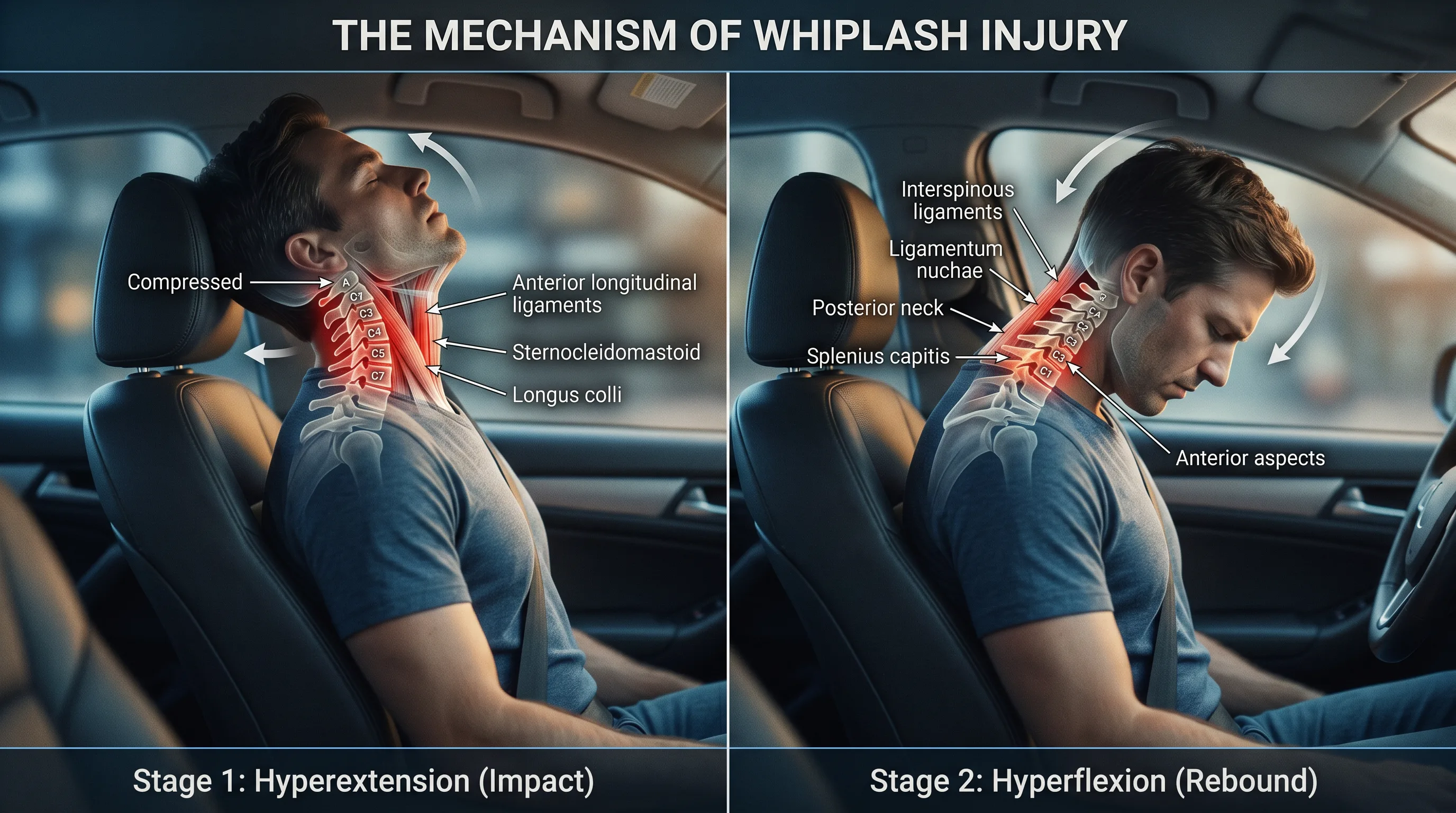
What Is Whiplash?
Whiplash — technically a cervical acceleration-deceleration (CAD) injury — is one of the most misunderstood and undertreated injuries in modern medicine. Despite being extremely common, affecting an estimated 3 million Americans annually, whiplash is frequently dismissed because it "doesn't show up" on standard imaging. This dismissal has led to an epidemic of chronic neck pain, headaches, and disability for people who were told their accident was "not that serious."
The mechanism of whiplash is straightforward: when a vehicle is struck from behind, the torso accelerates forward with the car while the head, being unsupported, initially stays behind — hyperextending the neck — and then snaps forward into hyperflexion. This rapid, forceful oscillation takes just 300 milliseconds, faster than the body's protective muscular reflexes can respond. The result is maximum stress on the passive stabilizing structures of the cervical spine: the ligaments, facet joint capsules, intervertebral discs, and anterior cervical muscles.
Critically, the severity of whiplash does not correlate reliably with the amount of vehicle damage. Studies have shown that low-speed rear-end collisions — even those that produce no visible vehicle damage — can generate sufficient head acceleration forces to cause significant cervical ligament injury. This is partly because modern vehicle bumpers are designed to absorb and release energy elastically, which can actually transmit more force to the occupants than older, softer bumpers.
Delayed Onset Symptoms: Why You Feel Fine at First
The body's acute stress response — a flood of adrenaline and endorphins triggered by the fight-or-flight system — temporarily suppresses pain signals. This is adaptive in genuinely life-threatening situations, allowing injured people to escape danger. But after a car accident, it means that the first 24–48 hours may be relatively pain-free, even when significant tissue damage has occurred.
As adrenaline levels normalize and tissue inflammation peaks over the following 24–72 hours, symptoms emerge: neck pain and stiffness, headaches beginning at the base of the skull, shoulder and upper back pain, arm pain or tingling, dizziness or balance disturbance, jaw pain (from TMJ loading during the impact), visual changes, fatigue, and in many cases, cognitive symptoms like difficulty concentrating — sometimes called "brain fog" or "whiplash-associated disorder cognition."
Patients who wait a week or more to seek evaluation often face skepticism about the cause of their symptoms, reduced insurance coverage, and injuries that have already begun the process of chronic scar tissue formation. This is why evaluation within 72 hours is so strongly recommended.
Why Digital Motion X-Ray Is Essential for Whiplash Diagnosis
The most important structure damaged in whiplash — the cervical ligaments — cannot be seen on standard static X-rays or even on conventional MRI. Ligaments appear normal on MRI unless there is a gross tear, but significant laxity (looseness due to micro-tearing and overstretching) produces the same instability and chronic pain as a complete tear without being visible on standard imaging.
Digital Motion X-Ray (DMX) solves this diagnostic problem by imaging the cervical spine in real time, while the patient moves through their full range of motion. The DMX captures frame-by-frame video as the neck bends forward, extends backward, and rotates side to side. The resulting study reveals abnormal translation (sliding) and angulation between adjacent vertebrae — the objective, measurable evidence of ligament damage that no other imaging modality can show.
For patients involved in personal injury cases, DMX findings are particularly valuable. They provide objective, reproducible evidence that is extremely compelling to insurance adjusters, defense attorneys, and juries. Central Illinois Spine is one of the few clinics in central Illinois capable of performing DMX, making us the preferred referral destination for attorneys representing accident victims throughout the McLean County region.
Our Whiplash Treatment Protocol
Whiplash treatment at Central Illinois Spine is individualized based on injury severity, DMX findings, and symptom presentation. For most patients, the protocol combines several approaches:
Chiropractic adjustments restore normal cervical joint motion, reduce facet joint inflammation, and address the mechanical dysfunction that perpetuates pain and limits recovery. Our physicians use gentle cervical techniques appropriate to the post-acute phase of healing, progressing to more specific manipulation as tissues heal.
Cervical spinal decompression is added when disc involvement is identified — either from MRI findings, radicular symptoms (arm pain/numbness), or significant foraminal narrowing on X-ray. The DRX 9000 in cervical mode creates the targeted decompressive forces needed to reduce disc pressure and facilitate disc healing.
Class IV laser therapy is one of the most powerful tools for whiplash soft-tissue healing. The deep-tissue laser penetrates to the level of the cervical spine, promoting cellular repair, reducing inflammation, and providing pain relief for the damaged muscles, ligaments, and joint capsules.
Cervical stabilization through physical therapy rebuilds the deep cervical flexor muscles — the primary dynamic stabilizers of the cervical spine — that are weakened and inhibited after whiplash injury. Reactivating these muscles is essential for preventing chronic instability and recurrent symptoms.
Most acute whiplash cases treated promptly resolve within 6–12 weeks. Cases involving significant ligament damage identified on DMX typically require longer treatment programs focused on maximizing stability and function in a cervical spine that will permanently have reduced ligamentous support.