
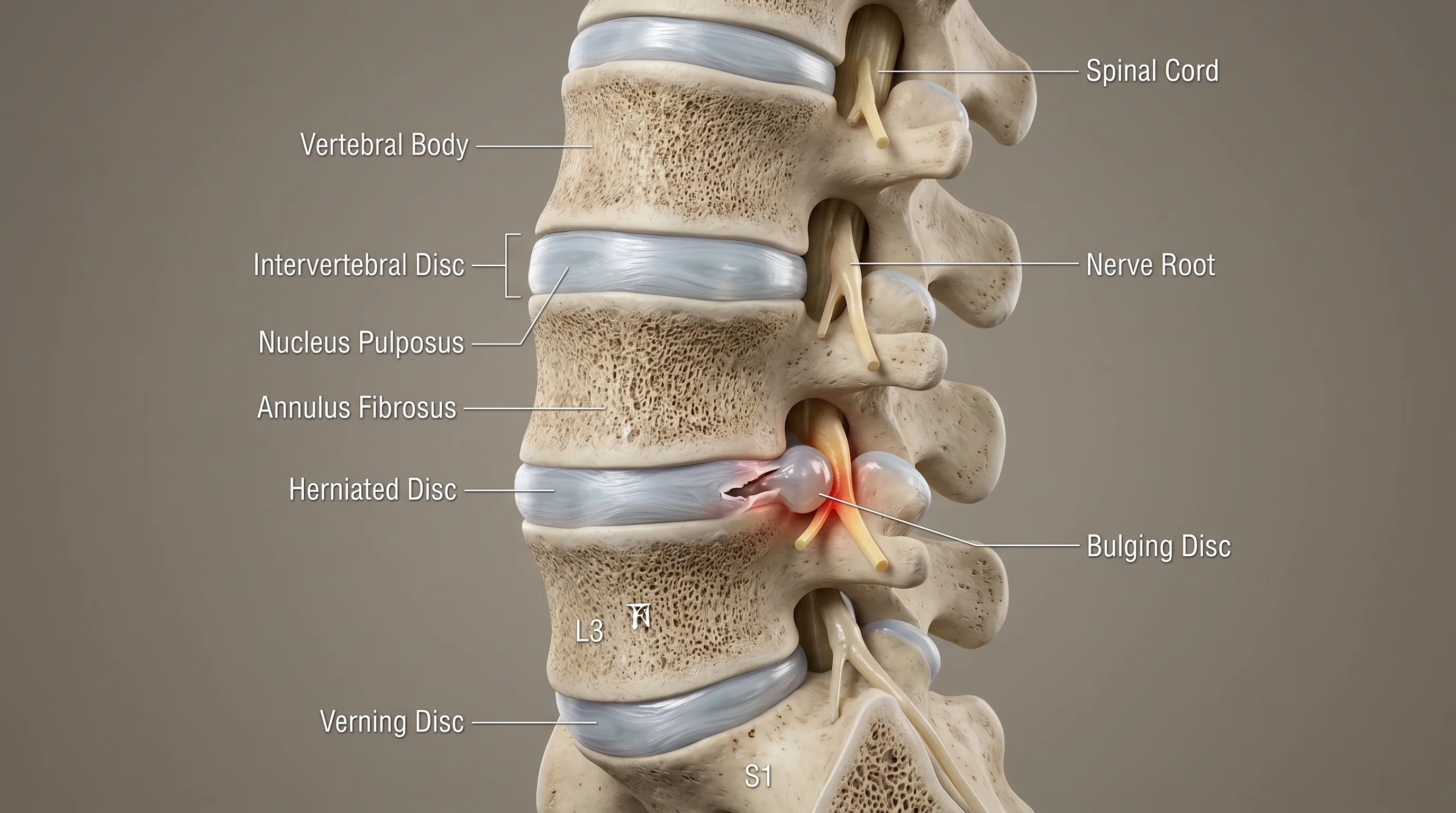
Understanding a Bulging Disc
A bulging disc — also called a disc protrusion — occurs when the tough outer ring of a spinal disc, known as the annulus fibrosus, weakens and allows the soft, gel-like interior (the nucleus pulposus) to push outward beyond the disc's normal boundary. Unlike a herniated disc, the outer wall of a bulging disc remains intact; no nucleus material actually escapes through a rupture. Think of it like squeezing a jelly doughnut from the top — the filling shifts to one side, but the dough doesn't break open.
Bulging discs can occur anywhere along the spine but are most common in two regions. In the lumbar spine (lower back), disc bulges typically occur at the L4–L5 or L5–S1 levels, where the greatest mechanical load is concentrated. In the cervical spine (neck), C5–C6 and C6–C7 are the most frequently affected levels. Thoracic disc bulges are less common due to the stabilizing effect of the rib cage.
When a disc bulges sufficiently, it encroaches on the spinal canal or the small openings (foramina) through which nerve roots exit the spine. This nerve compression is what generates most of the pain, numbness, tingling, and weakness that patients experience. The body's inflammatory response to an irritated disc can compound this compression, making even a modest bulge extremely painful.
Bulging discs frequently develop gradually, driven by cumulative mechanical stress — prolonged sitting, repetitive bending and lifting, poor posture, excess body weight, and the natural dehydration of discs that occurs with age. Because symptoms can build slowly, many patients are unaware of a problem until a disc bulge is far enough advanced to noticeably compress nerve tissue.
Common Symptoms
Symptoms of a bulging disc vary depending on the location of the affected disc and the degree of nerve involvement. Common presentations include:
- Radiating arm or leg pain: A cervical disc bulge typically produces pain that radiates from the neck into the shoulder, arm, or hand. A lumbar disc bulge sends pain into the buttock, thigh, calf, or foot — a pattern commonly called sciatica when the sciatic nerve is involved.
- Numbness and tingling: Patients often describe a "pins and needles" sensation or areas of deadened feeling in the extremities along the path of the affected nerve.
- Muscle weakness: Prolonged nerve compression can interfere with motor signals, producing weakness in the hand grip, wrist extension, hip flexors, quad muscles, or foot dorsiflexion depending on which nerve root is affected.
- Localized spine pain: Dull, aching pain at or near the disc level itself, often worsened by prolonged sitting, forward bending, coughing, or sneezing — activities that increase intradiscal pressure.
- Stiffness and reduced range of motion: Muscle guarding and inflammation around the affected disc often produce noticeable restriction in spinal movement, particularly in the morning or after periods of inactivity.
How We Treat Bulging Discs
Central Illinois Spine takes a comprehensive, non-surgical approach to bulging disc treatment. Every care plan begins with a thorough evaluation — detailed history, physical and neurological examination, orthopedic testing, and digital X-ray imaging. When available, MRI findings are reviewed to quantify disc involvement and guide treatment decisions.
Spinal decompression therapy on our DRX 9000 is the centerpiece of our bulging disc treatment protocol. The DRX 9000 is an FDA-cleared, computerized decompression system that applies precise, graduated distractive forces to targeted spinal segments. This creates a negative intradiscal pressure that gently draws the bulging disc material back toward its center, simultaneously pulling nutrient-rich fluid back into the dehydrated disc to promote healing from within. With six DRX 9000 machines on-site, we can accommodate multiple patients simultaneously and maintain consistent treatment schedules — a key factor in achieving optimal outcomes. No other clinic in the Bloomington-Normal area offers this capacity.
Chiropractic adjustments complement decompression by restoring proper segmental alignment and joint mobility throughout the spine. When vertebrae are misaligned, uneven pressure accelerates disc degeneration and perpetuates nerve irritation. Precise chiropractic manipulation reduces these asymmetric forces, improves spinal mechanics, and helps the nervous system function without interference. Our board-certified chiropractic physicians employ a range of techniques — from traditional manual adjusting to low-force instrument methods — ensuring every patient receives care appropriate to their condition and comfort level.
Physical therapy and core stabilization are essential components of any lasting bulging disc recovery. Strengthening the deep spinal stabilizers — the multifidus, transverse abdominis, and pelvic floor muscles — reduces the mechanical load on disc structures during daily activities. Stretching and mobility work addresses the hip tightness and postural imbalances that often contribute to disc stress in the first place. Our physical therapists work in the same facility as our chiropractors, enabling real-time coordination of care that accelerates recovery.
Class IV laser therapy provides an additional layer of healing support for patients with significant inflammation or soft-tissue involvement. High-powered therapeutic laser energy penetrates deeply into tissue, stimulating cellular energy production (ATP synthesis), reducing pro-inflammatory cytokines, and accelerating the body's natural repair processes. Patients frequently notice meaningful pain reduction after just a few laser sessions.
Bulging Disc vs. Herniated Disc
These terms are often used interchangeably, but they describe meaningfully different conditions. With a bulging disc, the annulus fibrosus (the disc's outer wall) remains structurally intact. The nucleus pushes outward in a broad, contained protrusion — the disc extends beyond its normal perimeter but has not ruptured. The bulge is typically broader and more diffuse.
With a herniated disc (also called a ruptured or slipped disc), the outer wall develops a tear or crack through which the nucleus pulposus escapes. This extruded nucleus material can directly contact, inflame, and compress nerve roots, producing more acute and often more severe symptoms. Herniated discs may also trigger a significant immune response to the nucleus material now outside the disc, adding a chemical inflammation component to the mechanical nerve compression.
In practical terms: bulging discs generally respond slightly more readily to conservative treatment because the disc structure remains intact and the nuclear material has not escaped. However, both conditions are very successfully treated at Central Illinois Spine using the same core combination of spinal decompression, chiropractic care, and physical therapy. Early intervention for either condition is strongly advised — an untreated bulging disc can progress to a herniation over time.
Central Illinois Spine is the right choice for bulging disc treatment in Bloomington-Normal for several compelling reasons. With six DRX 9000 spinal decompression machines — more than any other clinic in the region — we can deliver consistent, timely treatment schedules that produce superior outcomes. Our team of board-certified doctors of chiropractic brings over 20 years of focused spine care experience, and our integrated model — chiropractic, physical therapy, and advanced technology under one roof — means every aspect of your recovery is coordinated seamlessly. We have helped thousands of patients from Bloomington, Normal, and throughout McLean County avoid surgery and reclaim their lives.