
What Is Spinal Stenosis?
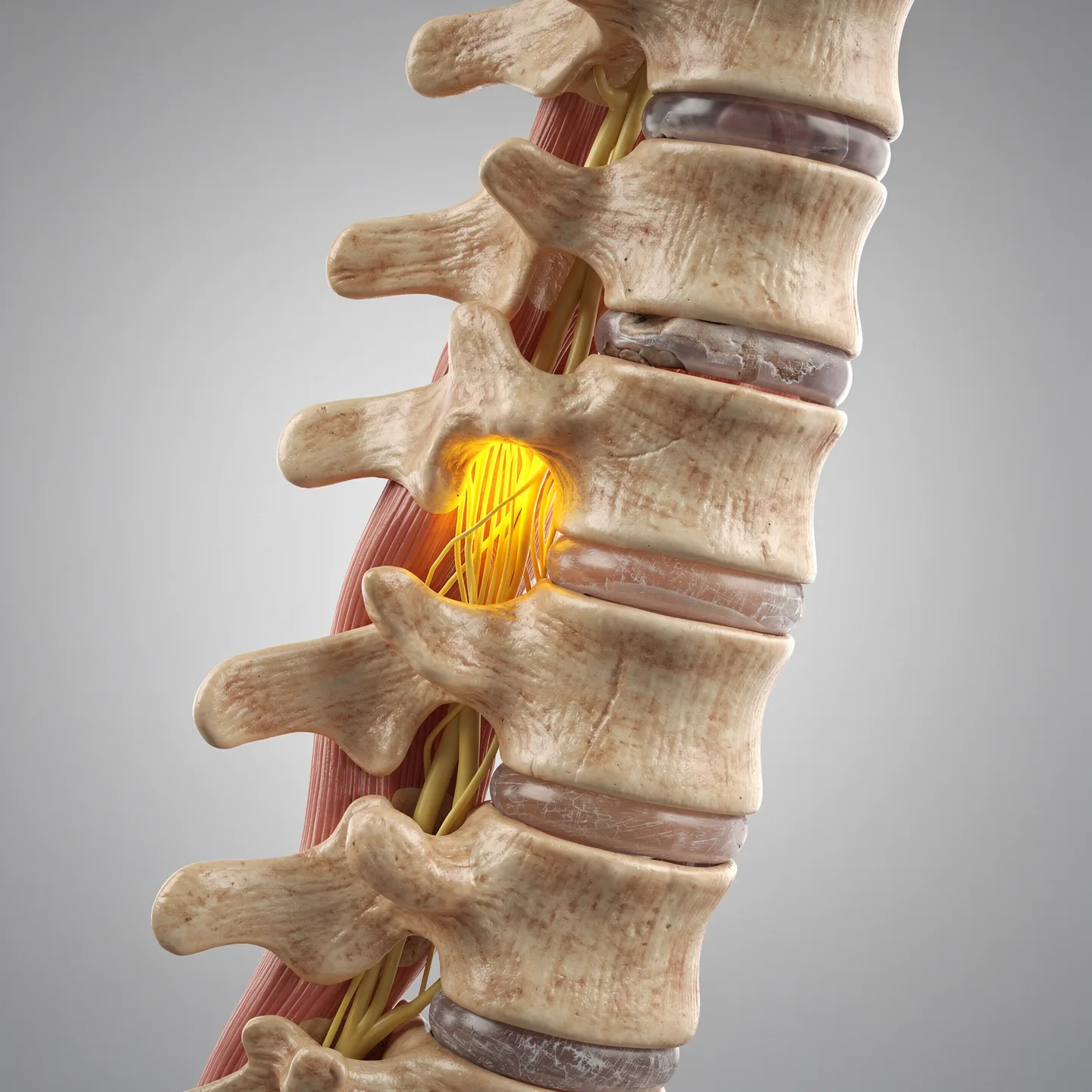
Your spinal canal is the bony tunnel that runs through your vertebrae and houses the spinal cord and cauda equina (the bundle of nerve roots below the cord). In a healthy spine, there is adequate space for those neural structures to travel unimpeded. Spinal stenosis is what happens when that space shrinks.
The narrowing can occur in the central canal (compressing the cord or cauda equina directly) or in the neural foramina — the side exits through which individual nerve roots leave the spine (foraminal stenosis). Both types produce nerve compression, but their symptom patterns differ slightly.
Stenosis is almost always a consequence of other degenerative processes. Bulging or herniated discs reduce the anterior-posterior diameter of the canal. Thickening of the ligamentum flavum (a ligament running along the back of the canal) reduces it from behind. Bone spur formation from degenerative disc disease and facet joint arthritis contributes from multiple directions. In advanced cases, multiple factors combine to produce significant canal narrowing at one or more spinal levels.
Central vs. Foraminal Stenosis
- Central stenosis narrows the main spinal canal, compressing the cauda equina (in the lumbar spine) or the spinal cord (in the cervical spine). This typically causes bilateral symptoms — pain, weakness, or numbness affecting both legs or both arms.
- Foraminal stenosis narrows the exit openings for individual nerve roots, producing symptoms on one side — very similar to a herniated disc radiculopathy. Commonly caused by bone spurs at the posterior facet joint or uncinate process.
The Hallmark Symptom: Neurogenic Claudication
If you find yourself having to stop and sit down or lean on a shopping cart after walking a certain distance, then experiencing relief once you rest — only for the pain to return when you start walking again — you may have neurogenic claudication. This is the defining symptom of lumbar spinal stenosis.
It occurs because standing and walking in an upright posture brings the lumbar spine into slight extension, which further narrows the already-compromised canal. Flexion — sitting, bending forward, cycling — opens the canal and temporarily relieves nerve compression, which is why stenosis patients often feel better on a recumbent bike than on a treadmill.
Additional symptoms of lumbar stenosis include:
- Low back, buttock, and leg pain worsened by standing and walking
- Leg heaviness, weakness, or cramping with activity
- Numbness or tingling in the thighs, calves, or feet
- Relief when sitting, bending forward, or lying in a fetal position
- In severe cases: bowel or bladder changes (seek immediate evaluation if present)
Non-Surgical Treatment for Spinal Stenosis
Surgery for spinal stenosis — typically a laminectomy (removing the lamina to decompress the canal) — is a significant procedure with real risks including infection, blood clots, failed back surgery syndrome, and adjacent-segment disease. Evidence shows that many patients with mild to moderate stenosis do not have better long-term outcomes with surgery than with rigorous conservative care. We always exhaust non-surgical options first.
Spinal Decompression — DRX 9000
The DRX 9000 creates a carefully controlled distraction force on the lumbar or cervical spine that temporarily increases the diameter of the spinal canal and neural foramina. This effect is most pronounced at the disc level — by reducing the disc bulge that contributes to canal narrowing, decompression directly addresses one of the primary mechanical causes of stenosis. Patients with stenosis secondary to disc bulging and ligamentum flavum hypertrophy often respond particularly well to this approach.
Sessions are comfortable and conducted with you lying on the padded DRX 9000 table. Each session lasts approximately 30 minutes. We begin with shorter distraction forces and gradually increase them over the first several sessions as your spine adapts.
Chiropractic Care
Facet joint restriction and misalignment reduce the diameter of the neural foramina and contribute to the mechanical compression of the canal. Targeted chiropractic adjustments using low-force and instrument-assisted techniques restore proper segmental motion, reduce facet joint crowding, and decrease the muscular tension patterns that worsen stenosis symptoms. Many stenosis patients find that regular chiropractic maintenance significantly extends the time between flares and reduces their overall pain level.
Physical Therapy and Postural Training
For stenosis, physical therapy focuses on flexion-based rehabilitation — exercises that keep the lumbar spine in slight flexion and strengthen the core stabilizers that prevent the spine from drifting into extension under load. We teach postural strategies for daily activities: how to walk with slight forward lean, how to use poles for support, how to configure your work station. These practical accommodations can significantly extend how far and long you can walk.
If you develop sudden onset bowel or bladder dysfunction, rapid onset bilateral leg weakness, or numbness in the groin/inner thigh (saddle anesthesia), go to the emergency room immediately. These signs may indicate cauda equina syndrome, a surgical emergency.