
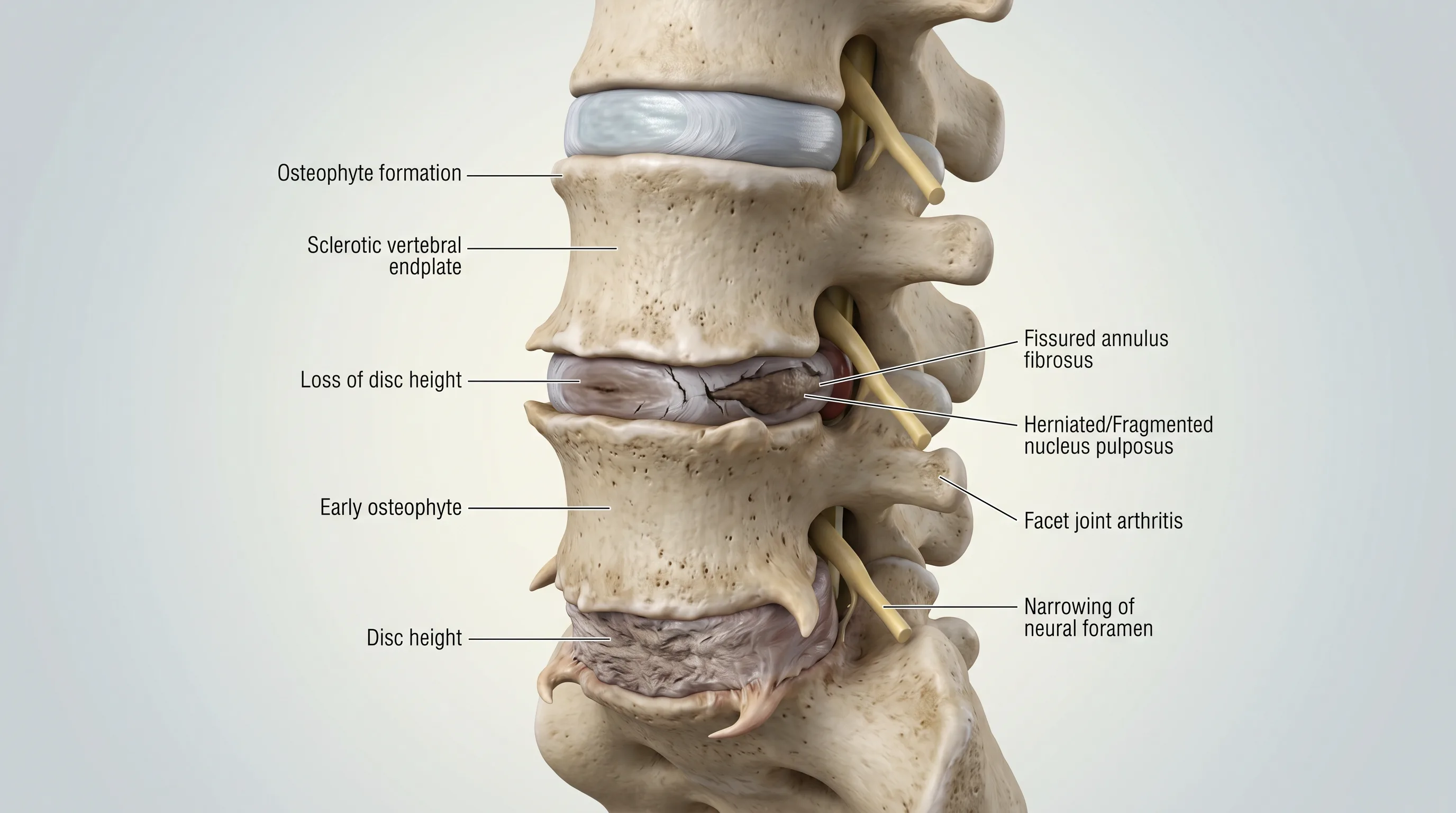
What Is Degenerative Disc Disease?
Despite its intimidating name, degenerative disc disease (DDD) is not truly a "disease" — it is a condition that describes the breakdown of the intervertebral discs over time. Think of your spinal discs as hydraulic cushions: they are roughly 80% water when healthy, and that fluid core gives them the ability to absorb the compressive and rotational forces placed on the spine all day long.
As we age — and especially as a result of accumulated mechanical stress, poor posture, or genetic predisposition — discs gradually lose their water content and begin to collapse. As disc height decreases, several problems emerge. The vertebrae above and below the affected segment sit closer together, which increases the load on the facet joints and can pinch nerve roots exiting the spine. The body often responds to this instability by forming bone spurs (osteophytes) in an attempt to stabilize the segment — but those bone spurs can themselves narrow the spinal canal or foramina, compressing nearby nerves.
How DDD Differs from a Herniated Disc
A herniated disc involves the nucleus pulposus actively pushing through the annulus fibrosus at a specific location and time. DDD, by contrast, is a more diffuse, chronic process in which the entire disc degrades gradually. That said, the two conditions frequently coexist — a chronically degenerated disc is structurally weaker and more prone to herniation. DDD also differs in its symptom pattern: rather than the sharp, radicular pain that often signals a herniation, DDD typically produces a deep, aching, chronic back or neck pain that is worsened by prolonged sitting or standing and relieved by movement.
Symptoms of Degenerative Disc Disease
- Chronic low-grade aching in the lower back or neck
- Pain that worsens after prolonged sitting (disc load increases in seated flexion)
- Morning stiffness that eases after 20–30 minutes of movement
- Intermittent episodes of acute "flare-ups" superimposed on baseline pain
- Radicular symptoms (leg or arm pain, numbness, tingling) if nerve roots are involved
- Reduced range of motion and flexibility in the affected spinal region
Why DDD Is Not a Life Sentence
Patients are sometimes given the impression that once their discs degenerate, nothing can be done. That's simply not accurate. While the disc aging process cannot be completely reversed, the pain and functional decline caused by DDD can be dramatically reduced with the right treatment approach. The key insight is this: degenerated discs are nutritionally starved. Because adult discs have no direct blood supply, they depend entirely on diffusion — the movement of fluid in and out of the disc through alternating pressure. Anything that improves that fluid exchange promotes disc health.
Our Approach to DDD Treatment
Spinal Decompression — DRX 9000
The DRX 9000 is particularly well-suited for DDD because it directly addresses the core problem: disc desiccation and height loss. By creating negative intradiscal pressure, the decompression cycle creates a pumping effect that draws in fluid, oxygen, and nutrients. Published clinical studies have documented measurable increases in disc height following decompression treatment courses. For patients with moderate DDD who are not yet experiencing severe nerve compression, this rehydration effect can be transformative — reducing pain, improving disc cushioning, and slowing further degeneration.
Our clinic operates six DRX 9000 units, which means we can offer frequent sessions (typically 4–5 per week in the early phase) without scheduling bottlenecks that would delay your progress.
Chiropractic Care for DDD
Degenerative segments often lose normal joint mobility, and adjacent healthy segments compensate by becoming hypermobile — setting them up for their own problems. Chiropractic care restores proper segmental motion across the entire spine, reducing compensatory stress and decreasing the mechanical load on the degenerated levels. Instrument-assisted and flexion-distraction techniques are particularly well-tolerated by DDD patients and can be performed even during flare-ups when traditional high-velocity adjustments may be uncomfortable.
Physical Therapy and Stabilization Exercise
Degenerated discs can no longer rely on their own hydraulic cushioning to the same degree, which means the spinal musculature must take on a greater share of the load. Our physical therapy program specifically targets the deep stabilizing muscles of the spine — the multifidus, transverse abdominis, and quadratus lumborum — that act as an internal brace. Stronger stabilizers dramatically reduce the compressive and shear forces that accelerate DDD progression and trigger painful flares.
If you have existing imaging, bring it to your first visit. Our doctors review your films personally to determine which disc levels are affected and which treatment approach is most appropriate for your specific presentation.